“Insufficient space prevents pigs from performing highly motivated behaviours, including exploratory, social, resting and thermoregulatory behaviours, and from maintaining separate dunging and lying areas.”
The period between weaning and slaughter, often referred to as the growing phase, makes up most of a pig’s life in modern farming systems. During this time, pigs experience rapid physical growth, major social changes, and prolonged exposure to the housing conditions that define their overall welfare.
Across much of the world, growing pigs are kept indoors in intensive systems that restrict movement, limit behavioural expression, and expose pigs to high levels of disease and stress. The welfare challenges faced during this stage are widespread and systemic, not limited to isolated cases.
Housing and Environment
In many countries, growing pigs are housed in large groups on fully or partially slatted floors designed for efficient manure removal rather than physical comfort. These environments are typically barren, with little or no bedding and few opportunities for pigs to explore, root, or manipulate materials.
Space allowance is often limited. While pigs may be able to stand and lie down, they frequently lack sufficient space to walk freely, avoid more dominant animals, or rest comfortably without disturbance. Overcrowding increases stress, soiling of resting areas, and competition for resources such as food and water.
Air quality is another major concern. Poor ventilation can lead to high levels of ammonia and dust, which irritate the respiratory tract and increase susceptibility to disease. Temperature control can also be a major challenge in indoor systems, contributing to thermal stress and discomfort.
Behaviour and Mental Wellbeing
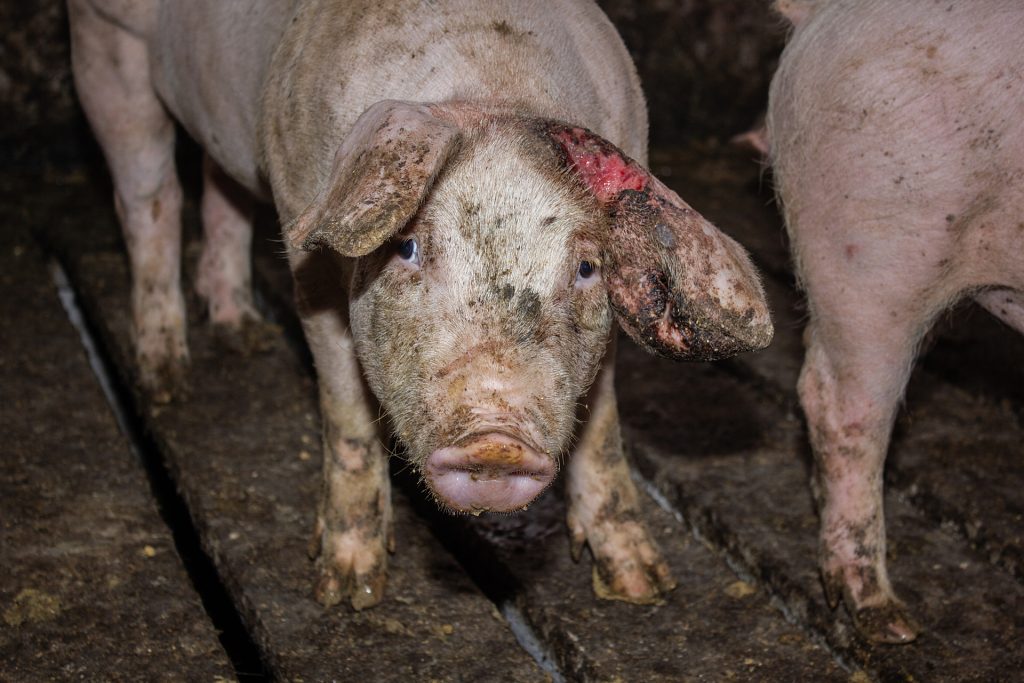
Growing pigs are highly motivated to explore their environment. In natural or enriched conditions, they spend much of their time rooting, foraging, and interacting socially. When these opportunities are denied, pigs often redirect their highly motivated behaviours in harmful ways.
Tail biting is one of the clearest indicators of poor welfare in growing pigs. It is an abnormal behaviour linked to boredom, frustration, lack of enrichment, high stocking density, and environmental instability. Rather than addressing these causes, modern pig production relies on tail amputation in early life to manage the consequences.
Aggression is also common, particularly when unfamiliar pigs are mixed. Fighting to establish dominance can lead to injuries, chronic stress, and fear, especially for less dominant animals. Stable social grouping and enriched environments can reduce aggression, but these measures are often absent in intensive systems.
Health and Disease
Stress, overcrowding and environmental deprivation all affect health. The weeks after weaning are associated with digestive upsets, including post-weaning diarrhoea caused by E. coli. Other common enteric conditions include ileitis and Salmonella, which can also pose risks to human health.
Respiratory diseases are widespread and are one of the leading health issues in growing pigs. Enzootic pneumonia , swine influenza, PRRS and Actinobacillus pleuropneumoniae all occur regularly in commercial units. Poor ventilation and high ammonia levels can damage the respiratory lining and increase susceptibility to these infections.
Lameness, hernias, prolapses and injuries from tail biting or aggression also occur. Studies of commercial finishing units repeatedly highlight the need for improvements in behavioural opportunity, air quality, stocking density and flooring to support better overall welfare.
Antibiotic Use
Because many health problems in growing pigs are closely linked to housing and management, antibiotic use is often high during this stage. Medications may treat symptoms, but they do not address underlying causes such as overcrowding, stress, poor air quality, and behavioural deprivation.
Reducing reliance on antibiotics therefore requires system-level changes. Improvements in space allowance, enrichment, ventilation, and overall welfare are central to preventing disease rather than reacting to it.

A Global Welfare Issue
The welfare challenges faced by growing pigs are remarkably similar across countries. Whether in Europe, North America, Asia, or Latin America, intensive indoor systems dominate pig production, and pigs experience many of the same constraints on behaviour and health.
While legal standards vary between countries, the biological needs of pigs do not. The persistence of routine tail amputation, high disease prevalence, and heavy antibiotic use highlights a global failure to design systems around pig welfare.
Summary
Growing pigs face prolonged welfare challenges throughout most of their lives. Barren environments, restricted movement, behavioural deprivation, and high disease pressure combine to undermine both physical and psychological wellbeing.
Improving the welfare of growing pigs requires rethinking housing and husbandry systems so that pigs can express natural behaviours, remain healthy, and live in environments that meet their basic needs.