“Overall, the EFSA experts are positive about moving from a crated farrowing systems to pen systems from an animal welfare point of view.”
Farrowing cages are narrow metal frames, usually placed within a slightly larger pen that allows piglets to move around the sow. Sows are typically confined from around one week before giving birth until their piglets are weaned, usually at three to four weeks of age.
Although some systems allow marginally more space than traditional cages, the defining feature remains the same. The sow is immobilised at the point when she is most strongly motivated to move, explore, and build a nest.
Global Use of Farrowing Cages
In most pig-producing countries and regions, including the United States, the European Union, China, and the UK, farrowing cages remain the dominant indoor farrowing system. Only a small number of countries, such as Sweden, Norway, and Switzerland, have banned their use entirely.
Life Inside a Farrowing Cage
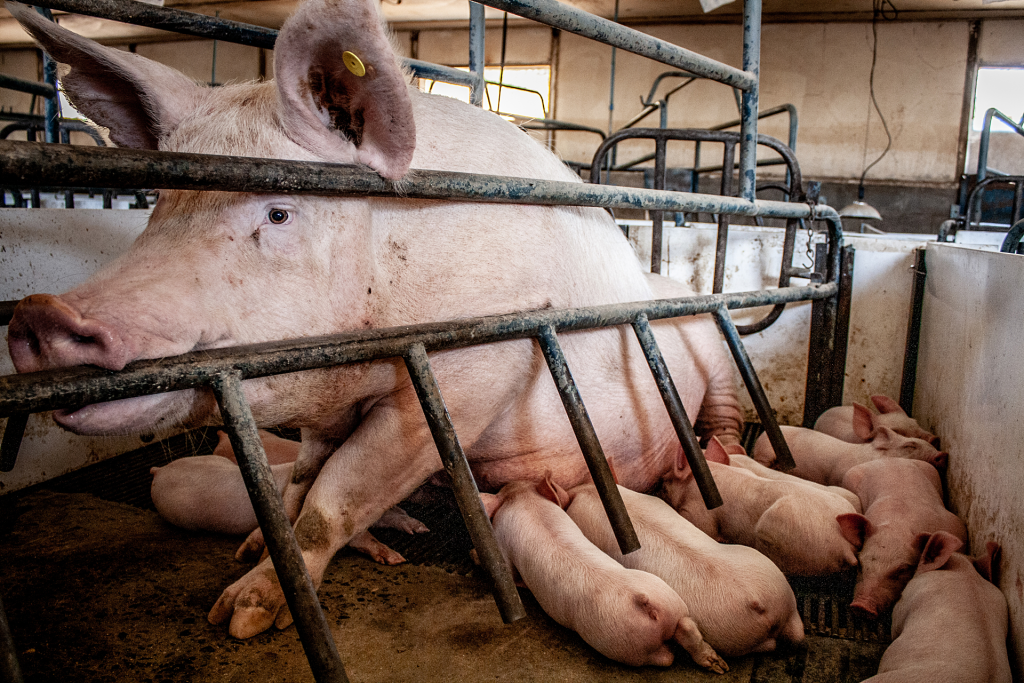
A sow kept in a farrowing cage cannot turn around, walk freely, or perform nest-building behaviour. She is prevented from responding naturally to her piglets and from choosing how to interact with them.
In natural or enriched environments, sows engage in intensive nest-building behaviour in the days before birth. This behaviour is hormonally driven and highly motivated. When sows are prevented from nesting, they often show signs of distress, including restlessness, repeated rooting at solid surfaces, and biting at bars.
The restriction imposed by farrowing cages therefore affects welfare not only through physical confinement, but through the frustration of powerful biological drives.
Physical Health Impacts
Extended confinement in farrowing cages is associated with a range of physical health problems. Sows spend long periods lying on hard floors with limited opportunity to change posture. This increases the risk of shoulder sores, skin lesions, and limb injuries.
Restricted movement also contributes to muscle loss and impaired circulation. Over repeated reproductive cycles, these impacts can accumulate, leading to chronic pain and reduced overall health.
These harms are not accidental side effects. They arise directly from systems designed to immobilise the sow rather than accommodate her biological needs.
Piglet Mortality and Industry Claims
The pig industry frequently claims that farrowing cages are necessary to prevent piglet crushing. It is true that piglet mortality is highest in the first few days after birth. However, this does not justify confining sows for several weeks.
Evidence from outdoor systems, free-farrowing pens, and countries that have banned farrowing cages shows that piglet mortality can be comparable to, or lower than, that seen in cage-based systems when housing is well designed and properly managed.
The continued use of farrowing cages reflects management convenience and economic priorities rather than an unavoidable welfare trade-off.
Temporary Cages and “Flexible Accommodation”
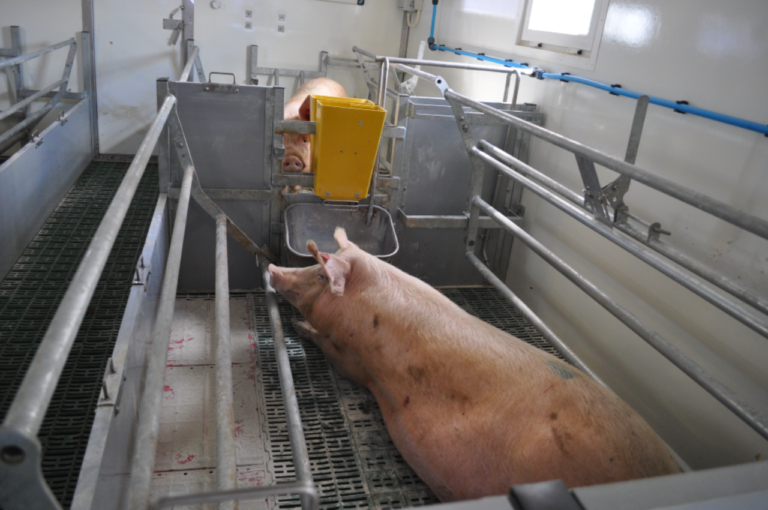
In response to growing pressure to ban farrowing cages, the industry has promoted so-called temporary cages, often described as “flexible farrowing”. Under these systems, sows are confined during the immediate period around birth and released later.
While presented as a compromise, temporary cages still prevent sows from turning around or nesting during a critical period. The welfare harms remain, even if the duration of confinement is reduced.
There are also serious concerns about enforcement. Once installed, there is no practical way to ensure that sows are confined only for the permitted legal period, particularly when economic incentives favour longer confinement. Temporary systems retain the logic of immobilisation rather than redesigning housing around sow welfare.
Permitting temporary cages without capacity for rigorous enforcement is deeply concerning, especially given that the industry in parts of the world has not implemented welfare-based reforms such as legislation that bans routine tail docking of piglets.
Scientific advisory bodies increasingly recognise that temporary cages should not be treated as an acceptable end point. Free-farrowing pens, designed to allow movement and nesting while managing piglet safety, are the appropriate alternative.
Language Matters
The way farrowing cages are described influences how they are perceived. Industry terms such as “crate” or “flexible accommodation” obscure the reality of confinement. These systems are cages in functional terms, restricting movement at a critical life stage.
Clear language helps the public and policymakers understand what is at stake. Referring to these systems as farrowing cages reflects the lived experience of the animal and avoids minimising the severity of confinement.
Global Use and Alternatives
Farrowing cages remain widespread across much of the world, particularly in large industrial systems. However, countries that have prohibited them demonstrate that alternatives exist, are practical and are commercially viable.
Free-farrowing pens and outdoor systems allow sows to turn around, nest, and interact more naturally with their piglets. When properly designed, these systems can achieve good welfare outcomes for the breeding sow without increasing piglet mortality.
The persistence of farrowing cages appears to reflect barriers to structural change, rather than a lack of viable alternatives.
Summary
Farrowing cages impose extreme restrictions on sows at one of the most sensitive periods of their lives. They prevent natural maternal behaviour, cause physical injury and psychological stress, and are maintained primarily for economic convenience.
Evidence from cage-free systems demonstrates that farrowing cages are clearly not necessary. Ending their use is an essential step towards farming systems that respect pigs as sentient mothers rather than considering them merely as economic units of production.