“Pigs show strong preferences to root with the nose and manipulate material with the mouth.”
Pigs are highly intelligent, social, and curious animals. Long before modern farming existed, their behaviour evolved in complex natural environments that allowed them to forage, build nests, form stable social groups, and raise their young over many months.
Although pigs have been domesticated for thousands of years, research shows that their basic behavioural motivations remain largely unchanged. When given space, materials, and social stability, domestic pigs quickly express the same behaviours as their wild relatives.
Understanding how pigs naturally live is therefore essential to understanding what good welfare really means, and why many modern farming systems fail to meet pigs’ most basic behavioural needs.
Life in Natural and Semi-Natural Environments
Wild boar and feral pigs live in varied landscapes such as woodlands, forest edges, and mixed farmland. These environments provide access to different food sources, shelter, and nesting materials, and allow pigs to move freely between resting and feeding areas.
Pigs in natural settings may travel long distances each day, exploring, foraging, and choosing where to rest. They regulate their own temperature by seeking shade, wallowing in mud, or resting on cool ground. They also choose when and where to interact socially, and when to withdraw.
This freedom of movement and choice is central to pig welfare. In contrast, many farmed pigs live in confined, barren environments where they cannot walk far, root in soil, wallow, or choose comfortable resting places. Limited space and lack of environmental complexity greatly reduce pigs’ ability to behave in ways that are natural and meaningful to them.
Pigs Are Explorers and Foragers
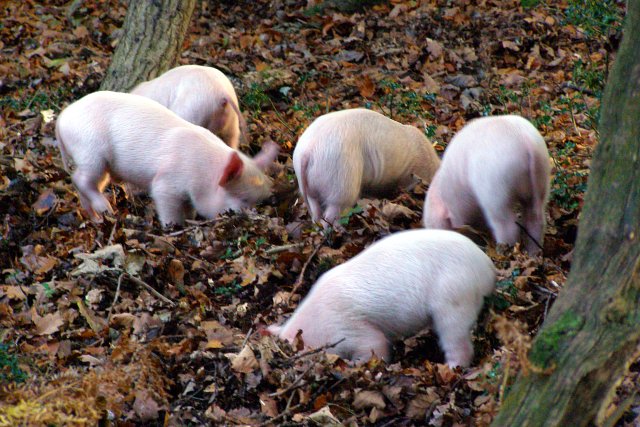
Rooting and exploration are among the strongest behavioural motivations in pigs. Using their sensitive snouts, pigs naturally dig in soil and vegetation to search for roots, insects, bulbs, seeds, and fallen fruit. Foraging occupies a large part of their daily activity and provides both physical exercise and mental stimulation.
Importantly, rooting is not just about hunger. Even well-fed pigs are highly motivated to explore their environment. When suitable materials are not available, pigs may redirect this behaviour toward pen fittings or toward other pigs, which can contribute to problems such as tail biting and aggression.
Providing straw, earth, or other manipulable materials allows pigs to express this natural behaviour and is consistently linked to reduced stress and better welfare. Environments that prevent rooting and exploration deprive pigs of one of their most fundamental behavioural needs.
Stable Social Groups and Long-Term Bonds
In natural conditions, pigs live in stable family groups known as sounders. These groups are usually made up of related adult females and their offspring, with social relationships that can last for years. Within these groups, pigs rest together, forage together, and show many affiliative behaviours such as gentle nose contact and social play.
Adult males usually leave the group at adolescence and live more independently, joining female groups mainly during the breeding season. This natural social structure minimises conflict and allows pigs to develop predictable relationships.
In contrast, commercial farming often involves mixing unfamiliar pigs at different stages of production. This repeated regrouping disrupts social stability and frequently leads to fighting, injuries, and prolonged stress. The natural pig social system is based on familiarity and long-term association, conditions that are rarely met in intensive farming systems.
Nest Building and Maternal Behaviour
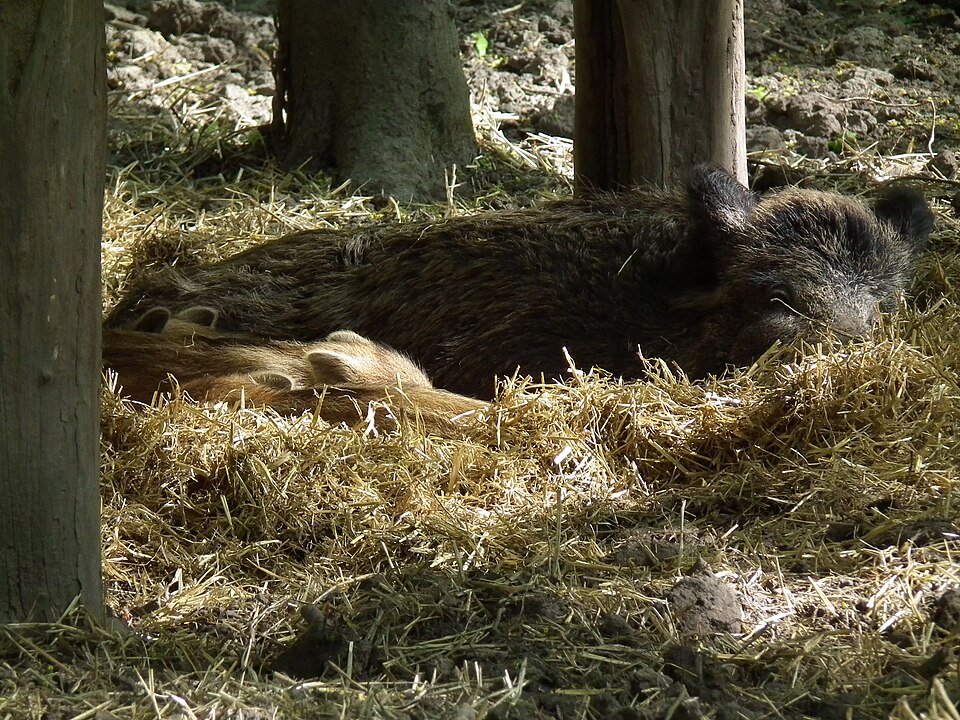
Few pig behaviours are as strongly motivated as nest building before birth. In natural conditions, a sow leaves her group shortly before farrowing and searches for a quiet, sheltered place. She gathers vegetation and builds a nest where she will give birth and care for her piglets.
This behaviour is driven by powerful hormonal changes and occurs even in highly domesticated sows. When nesting materials and space are not available, sows still attempt to perform the behaviour, often showing signs of frustration such as repeated rooting at hard floors or biting at bars.
After birth, the sow remains with her piglets in the nest for several days, nursing frequently and responding to their vocalisations. Only later does she rejoin the social group. Preventing nesting and restricting maternal behaviour does not simply limit movement, it blocks a deeply ingrained biological drive that is central to pig welfare.
Natural Weaning and Learning
In natural conditions, piglets remain with their mother for several months. Weaning is gradual, allowing piglets to learn foraging skills, social behaviour, and feeding patterns within the group. During this period, piglets also engage in frequent play, which supports physical development and social learning.
On many farms, piglets are separated from their mothers at just three to four weeks of age. This abrupt early weaning is associated with increased stress, higher disease risk, abnormal behaviours, and greater aggression. Removing piglets before natural behavioural development has occurred disrupts both emotional and physical development.
Natural pig development depends on time, social stability, and environmental complexity, all of which are greatly reduced in most intensive systems.
Why Natural Behaviour Is Central to Welfare
Animal welfare is not only about preventing disease or injury. It is also about whether animals can experience positive states and express behaviours that matter to them. For pigs, this includes rooting, exploring, forming social bonds, building nests, caring for young, playing, and choosing where and how to rest.
When pigs are unable to perform these behaviours, they experience frustration, stress, and behavioural deprivation. Many common welfare problems seen in farming — such as tail biting, aggression, and stereotypic behaviours — are symptoms of environments that fail to meet behavioural needs.
Farming systems that provide space, enrichment, stable social groups, nesting materials, and outdoor access are far better aligned with pigs’ natural behaviour. Understanding how pigs are biologically adapted to live provides a clear benchmark against which all pig farming systems should be judged.
Summary
Pigs are intelligent, social, and highly motivated animals whose behaviour evolved in complex natural environments. Domestication has not removed their need to explore, forage, build nests, form social bonds, and care for their young.
Modern farming systems that restrict movement, prevent rooting and nesting, disrupt social groups, and separate mothers from piglets early are fundamentally misaligned with pigs’ behavioural biology.
Protecting pig welfare means designing systems that respect what pigs are naturally driven to do, and not forcing pigs to adapt to environments that ignore their most basic needs.