“Exposure to CO₂ at high concentrations is considered a serious welfare concern by the Panel because it is highly aversive and causes pain, fear and respiratory distress.”
Each year worldwide, around 1.5 billion pigs are transported, stunned, and killed for meat. Although slaughter is often presented as a brief and regulated final stage, the methods used in modern pig production frequently cause severe suffering.
Across many of the world’s largest pig-producing countries, pigs are stunned using methods that cause intense fear, pain, and respiratory distress before loss of consciousness. These practices raise serious animal welfare concerns and challenge claims that pigs are killed humanely.
Transport and Pre-Slaughter Stress
Before slaughter, pigs are transported from farms to slaughterhouses, often over long distances. During transport, pigs may experience overcrowding, mixing with unfamiliar animals, temperature extremes, hunger, thirst, and fatigue.
On arrival at the slaughterhouse, pigs are moved through unfamiliar environments filled with noise, strong smells, and handling by humans. These conditions are highly stressful for pigs, who are sensitive to novelty and separation from familiar companions. Stress at this stage can be intense, prior to stunning and slaughter.
Carbon Dioxide Stunning
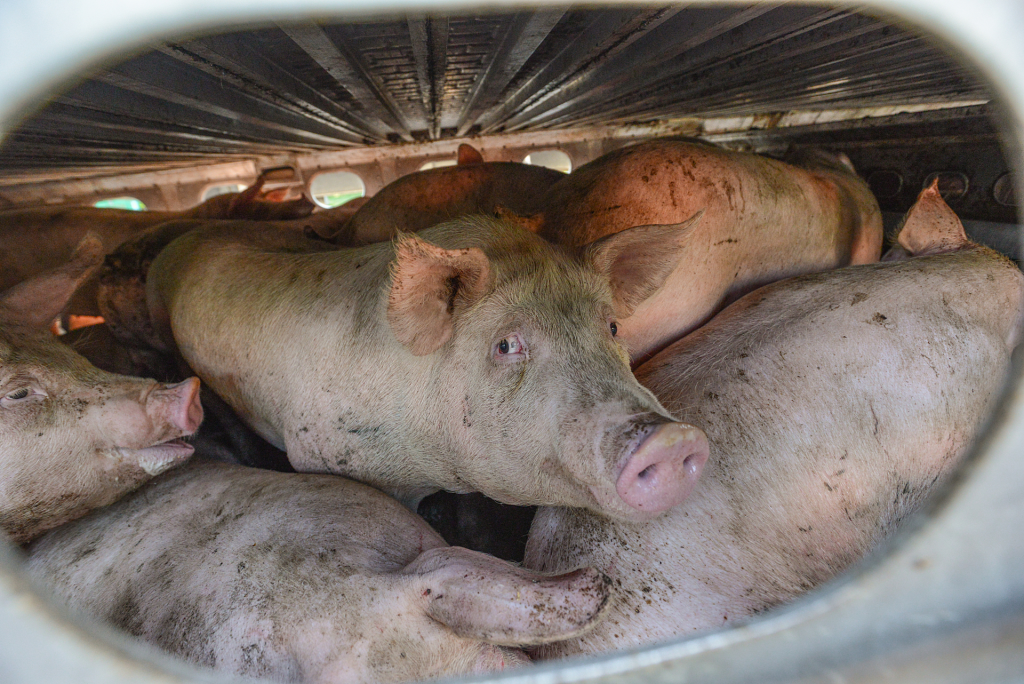
In many countries, including the UK, most of the European Union, and the United States, most pigs are stunned using high concentration carbon dioxide gas. Groups of pigs are lowered into a chamber filled with carbon dioxide, typically at concentrations exceeding 80 percent.
Carbon dioxide is highly aversive to pigs. When inhaled, it reacts with moisture in the respiratory tract to form carbonic acid, causing a burning sensation in the nose, throat, and lungs. Scientific evidence shows that pigs remain conscious for up to 30 to 60 seconds during exposure, experiencing air hunger, panic, and severe respiratory distress before losing consciousness.
During this period, pigs commonly gasp, vocalise, attempt to escape, and show signs of extreme fear. These reactions are not incidental. They are an inherent feature of carbon dioxide stunning and cannot be prevented through improved handling or design.
Scientific advisory bodies, including the European Food Safety Authority, have repeatedly concluded that high-concentration carbon dioxide stunning poses a serious welfare concern because of the intense suffering it causes before unconsciousness.
Electrical Stunning
Electrical stunning involves passing an electric current through the pig’s brain to induce unconsciousness. To apply the electrodes correctly, pigs must be restrained individually, often using narrow chutes or physical force.
This restraint process is highly stressful, particularly for pigs accustomed to moving in groups. Incorrect placement of electrodes, poor equipment maintenance, or rushed handling can result in pigs receiving painful electric shocks without effective stunning, leaving them conscious during bleeding.
While electrical stunning can render pigs unconscious quickly if performed correctly, in practice it carries significant welfare risks and is often poorly implemented in high-throughput slaughter systems.
Why These Methods Persist
Carbon dioxide stunning remains dominant largely because it allows large numbers of pigs to be processed quickly and reduces the need for individual restraint. These operational advantages benefit slaughterhouse efficiency, not animal welfare.
Similarly, electrical stunning persists because it is relatively inexpensive and widely established, even though it requires precise handling to avoid serious welfare failures.
The continued use of these methods reflects economic priorities and institutional inertia rather than a lack of more humane alternatives.
More Humane Alternatives
More humane alternatives to carbon dioxide stunning exist. Inert gases such as argon or nitrogen can induce unconsciousness without causing the severe respiratory distress associated with carbon dioxide. Studies show that pigs exposed to inert gases lose consciousness with significantly less aversion.
Improved electrical stunning systems and new technologies are also being explored. However, progress has been slow, and uptake remains limited due to cost, infrastructure changes, and lack of regulatory pressure.
Where alternatives have been trialled, they demonstrate that reducing suffering at slaughter is technically feasible.
A Hidden Welfare Issue
Public awareness of pig slaughter methods is extremely low. Most consumers are unaware that carbon dioxide gas is widely used, or that pigs experience intense distress before losing consciousness. This lack of transparency allows harmful practices to continue largely out of sight. Claims of “humane slaughter” often rely on legal compliance rather than meaningful welfare outcomes.
A Global Problem
Inhumane pig slaughter is not confined to any one country. Carbon dioxide stunning and problematic electrical stunning are used across Europe, North America, and other major pig-producing regions. In many countries, oversight and enforcement are weak, and welfare failures go unreported.
The global scale of pig slaughter means that even small welfare improvements could reduce suffering for millions of animals. Conversely, failure to act perpetuates large-scale harm.